The speed of sound — the “Lucchi value”
The quantity measured is the speed of sound propagation (C) through wood (and other materials), expressed in m/sec. It is an objective physical quantity, computed as the ratio between the length of the sample (in mm) and the time an ultrasonic pulse takes to travel through it (in microseconds). For brevity and by convention, this speed of sound is commonly called the “Lucchi value”: an informal, widespread label, not a new physical parameter.
The higher the speed, the better the wood transmits vibrations — a fundamental property for the acoustic quality of a musical instrument. The name "Lucchi value" is informal but recognised worldwide since 1983, when Giovanni Lucchi developed the first prototype in Cremona. The instrument itself is also sometimes informally spelled LUCCIMETER or LUCCI METER (without the "h"), as a tribute to the inventor's surname.
Lucchi value formula
Lucchi (m/sec) = (mm / microsec) × 1000
600 / 117 × 1000 ≈ 5128 m/sec — a typical value for a medium-quality Pernambuco bow stick.
Why the speed of sound, and not Young's modulus alone
One might think that Young's modulus — the stiffness of the wood — would be enough to tell how good a piece of wood is. It is not: Young's modulus measures the force of the material, not its ability to vibrate and return harmonics. Two pieces of wood with the same Young's modulus can have very different speeds of sound — and therefore very different acoustic behaviour.
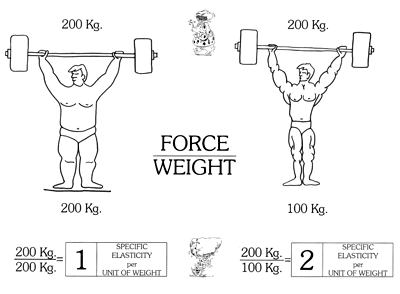
| Material | Speed (m/sec) | Density | Q factor | Specific elasticity | Young’s modulus |
|---|---|---|---|---|---|
| Spruce 1 | 6300 | 0.39 | 210 | 396.9 | 119 |
| Spruce 2 | 4280 | 0.65 | 65 | 183.1 | 119 |
This is also why the speed of sound is the parameter Giovanni Lucchi chose in 1983. The in-depth material — including the "Young can cheat" series and the comparison of species with the same Young's modulus — is collected on the Resources page.
The physical principle
The measurement is carried out by placing two probes at the ends of the wood sample:
- the TX probe (transmitter) generates a short ultrasonic pulse;
- the RX probe (receiver) detects it after it has travelled through the wood.
The instrument measures the time of flight of the pulse (in microseconds). Knowing the distance between the probes, it can compute the speed of sound propagation (C).
Longitudinal and transverse speed
The LucchiMeter always returns the speed along the probe alignment direction. The direction of measurement has a precise physical meaning:
- by orienting the probes along the wood fibres you measure the longitudinal speed (the highest);
- by orienting them perpendicular to the fibres you measure the transverse speed (markedly lower).
For two-dimensional soundboards (such as violin tops), both measurements are needed: the longitudinal and transverse values can differ widely, and their ratio is an important indicator of the internal structure of the wood.
Measurement procedure — in brief
Day-to-day use of the LucchiMeter follows three essential steps:
- SET ZERO — the cable tare of the probes, to be performed on first use and whenever probes are replaced. Flat-rubber probe against pointed-rubber probe, light and steady pressure. This is the only true calibration of the instrument.
- Measuring the sample length — with a tape measure or a caliper, in millimetres.
- Measuring the propagation time — by placing the probes at the two ends of the sample, along the direction you want to evaluate. The Lucchi value is computed automatically by the LucchiMeter PRO; on the BASIC it is derived by hand using the formula above.
What it measures, what it does not
The LucchiMeter measures: the speed of sound in a specific direction of the wood, non-destructively and reproducibly. From this quantity follow reliable indications about apparent density, fibre homogeneity, presence of internal defects and overall acoustic quality.
The LucchiMeter does not measure: the colour of the wood, the subjective "sound" a musician will perceive on the finished instrument, nor does it guarantee on its own the success of the violin maker's work. It is an instrument for selection and control, not an aesthetic judge — the maker remains at the centre of the process.