Seven areas of use
Applications
The LucchiMeter follows the work of those who select, cut, shape and evaluate tonewood — from the forest to the workshop, from the log to the finished instrument. Seven concrete fields of application, consolidated over more than forty years of practice.
01 · Bow makers
Pernambuco selection for bows
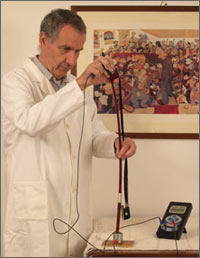
Bow making is the historical field in which the LucchiMeter was born. Giovanni Lucchi developed the first prototype in 1983 specifically to choose Pernambuco for bows for violin, viola, cello and double bass. Since then, the speed of sound propagation (C) along the fibres has been the reference parameter to estimate at a glance the quality of a stick: the higher the speed, the more responsive the stick, the richer in harmonics, the more capable of returning every nuance of the bowstroke.
Measuring Pernambuco with the LucchiMeter allows selecting the raw material before even working it, setting an objective price, documenting each piece with a reproducible numerical value. For the practical thresholds of Lucchi value on Pernambuco, see the Reference Values page.
02 · Violin makers
Spruce and maple for the violin family
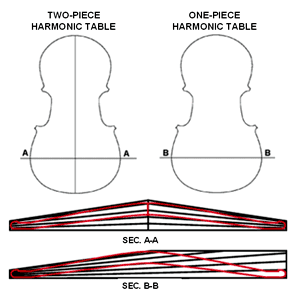
In the construction of violins, violas, cellos and double basses, the LucchiMeter follows two parallel choices: spruce for the soundboard (the top), maple for the back, ribs and neck. On the soundboard in particular, two measurements matter: the longitudinal speed (along the fibres) and the transverse speed (perpendicular to them). For soundboards, which are two-dimensional structures, both are needed — their ratio is an important indicator of the internal structure of the wood.
Traditionally, sound speed is also associated with the resonance coefficient R = C / ρ (speed divided by apparent density), a quantity many violin makers use as a second selection criterion, especially for spruce. The LucchiMeter directly provides the numerator of this relationship.
03 · Guitar makers
Tops, backs and necks for acoustic guitars
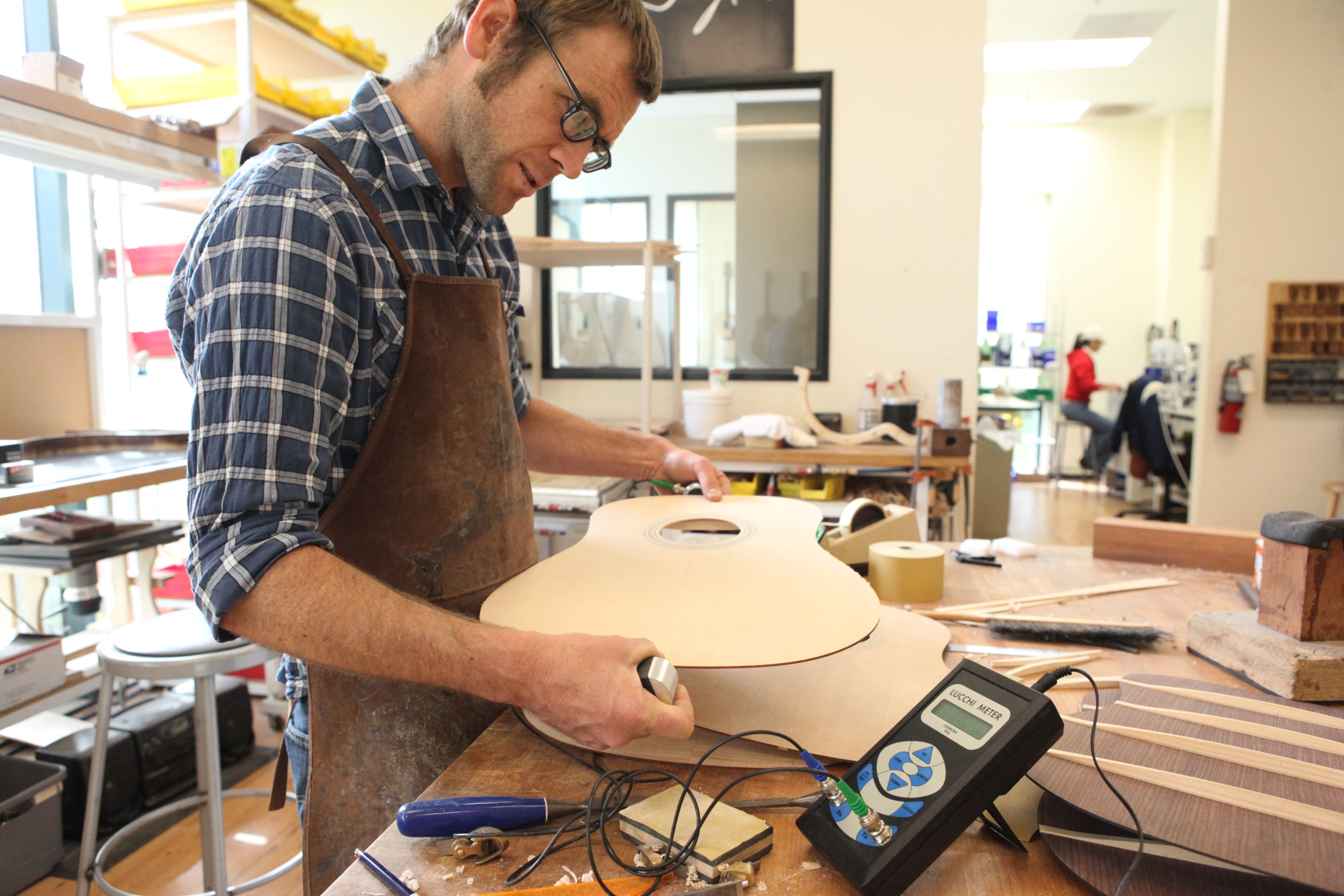
Over the last twenty years, the LucchiMeter has also become a routine instrument in guitar makers' workshops, both for classical and acoustic guitars. It is applied to spruce or cedar tops, to braces, to rosewood, mahogany or maple backs, and to mahogany or maple necks. The principle is the same as for the violin: sound speed along the fibres is an objective indicator of wood homogeneity and potential acoustic quality.
04 · Wood selection
Selection and trade of tonewood
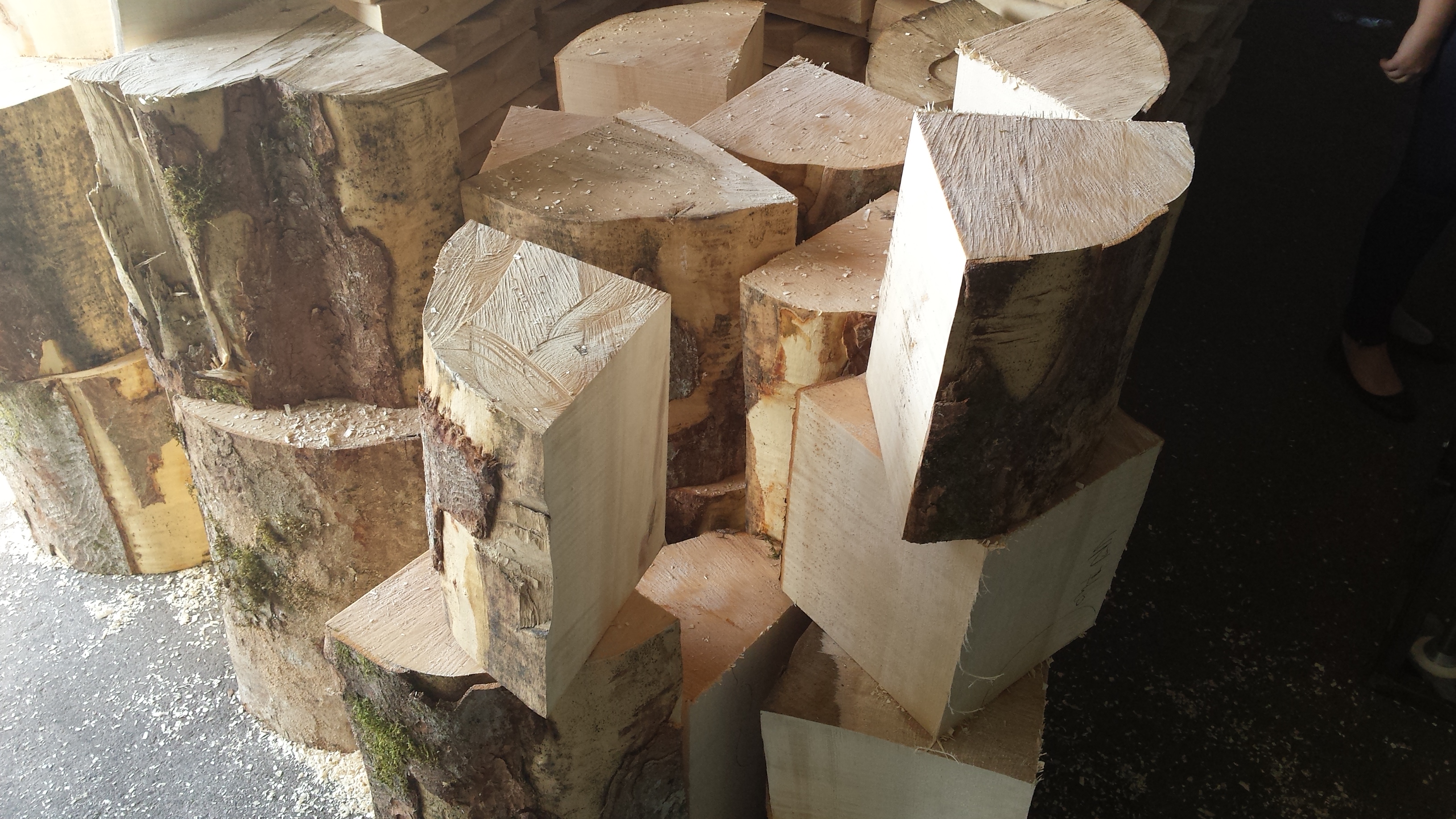
For tonewood traders and warehouses supplying violin makers and bow makers' workshops worldwide, the Lucchi value is the numerical parameter on which price lists are written. Each piece is measured and accompanied by its Lucchi value in m/sec — a common and objective language that allows the exchange of precise information without the need to physically see the wood.
The measurement is non-destructive, fast, reproducible, and requires no sample preparation. It applies to the whole log, to already sawn boards, to semi-finished pieces. It is the same measurement the violin maker or bow maker will repeat in the workshop before starting to work — so the data provided by the trader is verifiable and defends itself.
05 · Log cutting
Verification of cutting choices
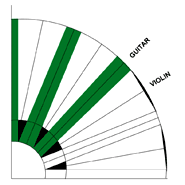
When a spruce or maple log arrives at the sawmill, the cutting choices — which radial cut to make, from which sector of the log to obtain which boards — largely determine the acoustic value of the material that will come out. Measuring sound speed directly on the whole log, or on the first sectioned boards, allows to orient the subsequent cuts towards the acoustically best portions of wood.
A famous example is the work done by Fazioli on the logs destined for piano soundboards, where the LucchiMeter was used to orient the cuts and get the maximum out of the raw material. The same principle applies to spruce for violin soundboards.
06 · Treatment verification
Effect of varnish, oils, seasoning
Every treatment applied to wood — varnishes, oils, impregnants, accelerated seasoning processes or stabilisation — modifies the speed of sound to a variable extent. The LucchiMeter makes it possible to quantify this effect by measuring the same piece before and after the treatment, and to compare different protocols with reproducible criteria.
Wood moisture, in particular, has a systematic and predictable effect on the Lucchi value: a freshly cut piece (moisture ≈ 40%) returns appreciably lower readings than the same piece once seasoned (equilibrium moisture 8–12%). On spruce, the empirical relationship observed is approximately "−1% moisture ≈ +1% Lucchi value", useful as an order of magnitude to estimate the final value of a still-fresh piece.
07 · Finished instruments
Evaluation of completed bows, violins, guitars
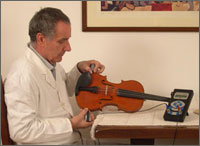
The LucchiMeter is also applied to the evaluation of already completed instruments, where it allows estimating the original Lucchi value of the wood before processing. On finished bows, for example, the presence of the mortise for the frog and the hole for the button systematically lowers the reading compared to the intact wood: by applying a percentage correction (on average 2.2% for violin, 2.3% for viola, 2.6% for cello, 3.6% for double bass) the original value can be derived.
The same applies to violin soundboards: the cutting of the F-holes lowers the measured speed by about 8%. It is a precious figure for researchers and connoisseurs of antique instruments, because it allows building numerical catalogues of lutes, violins, bows of the past and comparing them on an objective basis.
For the details of formulas and correction values, see the PRO model manual (chapter 8 — Advanced Settings).